The right way to use AI to become a better PMM
- Jun 9
- 11 min read
Updated: Jun 10
Introducing: The AI PMM AcademyI'm launching the AI PMM Academy: a program for PMMs to hone their craft alongside peers and learn how to use AI in a way that amplifies, not replaces, their expertise. I'll share more at the end of the newsletter. |
AI anxiety
I've spent the last few weeks traveling to events and meeting PMMs, leaders, VCs, and founders. Everywhere I've gone, the conversation eventually turns to AI.
There have been thoughtful discussions about how AI is changing our roles, GTM motions, and the way work gets done. But one thing has become increasingly clear: nobody has it all figured out. Even at the largest companies, people are navigating uncertainty with little guidance, evolving expectations, and very few established playbooks. Beneath all the excitement, there's a shared concern that we're somehow missing something important.
Of course, that doesn't stop the AI hype machine from churning.
This LinkedIn post I wrote resonated with many people, perhaps because it acknowledged the importance of AI without stoking fear. The message was simple: the skills that matter most haven't disappeared. Storytelling, judgment, relationship building, workflow design, and business acumen still matter. In many ways, they matter more than ever.
That observation has only become stronger the more people I talk to.
The PMMs getting the most value from AI aren't necessarily the ones chasing every new tool, building the most sophisticated workflows, or spending all day on social media. They're the ones with strong fundamentals who are using AI intentionally.
I’ve written about AI before (here and here), but for this issue, rather than give you another list of tools or templates, I want to share the framework I've been using to think about using AI to become a better PMM.
It starts with two principles:
Protect your moat.
Protect your human intelligence.
It then walks through exactly how I think about applying AI in product marketing today. But first, let's start with what matters most.
Principle #1: Protect your moat
Before we talk about AI, we need to talk about something more important: why your role exists in the first place.
Companies don't pay PMMs to generate content. They pay PMMs to create clarity and help products succeed in the market.
That's your moat.
And contrary to what some people fear, AI doesn't diminish that moat. If anything, it makes it more valuable. As AI becomes more capable, the quality of your human judgment matters even more.
Here's what that moat looks like in practice:
Telling the best stories - AI can't decide which customer insight matters most, which narrative will resonate, or how to connect a product to a larger business problem. That's why even AI companies are hiring storytelling leaders. I've seen the same thing in recruiting: the best PMMs now command up to $50K in salary increases due to their storytelling/positioning abilities.
Setting the bar for quality - The flood of AI-generated content has made judgment more important, not less. Your value isn't producing more content. It's knowing what's worth publishing, what's incomplete, what's misleading, and what will actually resonate with customers. When there is more and more slop on the market, the role of the “quality checker” becomes more important.
Being the strategist - You can ask Claude to build a launch plan in seconds. The problem is that it won't know your internal dynamics or how to be original in reaching your customers. That’s why we end up with many cookie-cutter, checklist-based launches that don’t move the needle. Strategy requires context and first principles thinking.
Being the connector - This may be the most important moat of all. Companies are made of people, and people are messy. AI can't tell you which AE is the right partner for a pilot program, convince your CPO that a roadmap change is necessary, or navigate the complex stakeholder dynamics that make or break great work. Influence remains one of the most valuable skills in business because it is one of the hardest to automate.
Principle #2: Protect Your Human Intelligence
Understanding your moat is only half the equation. The next challenge is protecting the thing that powers it: your human intelligence.
Something nearly everyone brought up with me is the AI brain rot. While the risk of AI replacing your job is real, the risk that your brain’s function will decline over time is significantly more dangerous, with lifelong consequences.
This is because your skills in storytelling, judgment, strategic thinking, and influence aren't fixed traits. They are capabilities that strengthen through practice and weaken through neglect. If we outsource too much of our thinking to AI, we risk outsourcing the very skills that make us valuable.
To avoid that:
Use your brain first, AI second - Multiple studies (like this one) have shown that thinking critically first and then turning to AI for assistance helps preserve learning and decision-making skills. So, resist the urge to solve strategic or challenging problems with AI first. Instead, try your best to come up with your own approach, then use AI to critique and enhance it.
Invest in craft development - Nobody went to school for product marketing, and there is no universally accepted benchmark for excellence. Most of us are learning on the job. That's exactly why you can't let AI do all the heavy lifting. Push yourself to understand the reasoning behind recommendations instead of blindly accepting them.
Get human feedback - One of the dangers of AI is that it's endlessly supportive. It rarely tells you your positioning is weak, your strategy is flawed, or your messaging isn't landing. Humans do. Whether it's a peer, mentor, manager, coach, or someone you admire, seek out people who will challenge your thinking instead of simply validating it.
Seek first-hand insight - AI is trained on existing information, but your best insights come from living in the analog world. Talk to customers. Listen to sales calls (and I mean, actually watch the calls instead of just using AI transcripts). Pay attention to stakeholder reactions. The more AI becomes part of your workflow, the more important it becomes to stay connected to the messy, human realities that generate original thinking.
I learned this lesson when I tried to build an automated workflow for my LinkedIn content. I spent days feeding AI my past posts and more context, hoping it could generate new ideas for me. The results were terrible. It’s because my best content doesn't come from old content. It comes from coaching conversations, client work, travel, and observations I make in the real world.
A Practical Framework for Applying AI
Once you've protected your moat and your human intelligence, the next question becomes:
Where should AI actually fit into your work?
This is where you need a very clear plan to maximize the value out of it (while protecting your moat/brain). So let’s dive in.
Step 1: Understand the Three Types of AI Workflows
Over the past year, I've found it helpful to think about AI workflows in three categories. The category determines not only the workflow you build, but also the role AI should play.

Level 1: Execution Workflows
This is repetitive, reviewable, shippable work such as repurposing content, aggregating data, summarizing research, writing release notes, and coordinating information across teams.
This is where the biggest time savings live, and it's where almost every PMM should start. The work is relatively low risk, the gains are immediate, and the time savings compound quickly.
Level 2: Thinking Workflows
This is where AI becomes a thought partner. You might use it to sharpen messaging, synthesize patterns, pressure-test positioning, refine a launch strategy, or explore different options. Unlike execution workflows, these tasks require conversation and iteration rather than automation.
For many PMMs, this becomes a daily companion (like Chat) rather than a fully automated workflow.
Level 3: Scaling Workflows
This is where many people get AI strategy wrong.
There's a belief that advantage comes from building increasingly complex agents or massive end-to-end workflows. In reality, autonomous agents are often quite poor at PMM work because PMM work is full of nuance, judgment, stakeholder management, and context.
The strongest PMMs aren't necessarily using the most advanced tools. They're thinking clearly about work design.
Take content creation as an example. Instead of building one giant workflow that handles everything, start with a process you already understand deeply and perform manually today. Break it into pieces. Understand where the friction points are. Then identify where AI can improve the work at each stage and connect those pieces intentionally.
Step 2: Find the Right Use Case
The next challenge is choosing the right use case.
The most helpful way to determine your initial use case is by tracking how you are spending your time. Many of us spend time on things that don't add a ton of value (e.g., spending way too long rewriting similar Slack messages).
Map out your week and estimate where your time goes. Most PMMs will find their work falls into a handful of broad buckets:
Content creation
Admin and coordination
Research and analysis
Customer and market understanding
Strategy and planning
Stakeholder management
Then compare that to how you'd ideally spend your time.
The biggest gap often reveals your best AI opportunity.
For many PMMs, the highest-leverage opportunities tend to sit inside content creation and admin work because these areas contain a lot of repetitive, time-intensive tasks where the thinking has already happened.

Once you've identified the category where you spend the most time, the next step is selecting a specific use case within it. For example, if "content creation" is consuming too much of your time, you need to identify the specific workflow within that category.
That might be:
Turning launch briefs into sales enablement assets
Repurposing webinars into social content
Drafting release notes
Creating customer-facing emails
Formatting competitive intelligence updates
A good way to pick a good use case from your list (such as from the one above) is to check it against 3 key filters. If you can say “yes” to the three questions below, then it’s likely the best place to start:
Does it recur frequently? Weekly, monthly, quarterly; the more it repeats, the more your workflow compounds over time.
Is quality limited by time, not thinking? Many tasks look like they're limited by time, but when you dig deeper, the real bottleneck is judgment. For example, AI can summarize ten customer interviews in minutes. But deciding which insight matters most, how it should influence your positioning, or whether it reflects a broader market trend requires judgment. If the thinking has already happened, AI can create significant leverage. If your judgment is what drives quality, AI is more likely to play a supporting role.
Can it be done without significant relationship context or political judgment? This filter can also be hard to discern, but it’s incredibly important because the nature of product marketing work is uniquely relationship-based. Take something like positioning and messaging: you can feed April Dunford’s framework into AI, but you’re going to fail if you can’t get stakeholders aligned around it. Your uniqueness doesn’t lie in your ability to spit out a document; it comes from bringing stakeholders together, resolving any conflict, and actually moving forward with something everyone agrees on.
Example: One PMM’s Slack Intelligence Digest A client of mine is one of many PMMs at an 5,000-person company with 20+ products. Staying on top of eight relevant Slack channels, including global sales regions and industry news feeds, was consuming a huge amount of time every morning. Only a small percentage was relevant to her product area, while the rest was just a distraction. So she built a Cowork-scheduled digest that runs daily at 9 am, reads her specific channels, filters for what's relevant to her product area and key competitors, and returns three categories: what to read first, what to skim, and what to skip entirely. The best part is that if she's been offline for multiple days, it adjusts automatically to give her a consolidated summary instead of stacking up 20 individual outputs. She isn’t asking AI to make decisions; she’s having it triage so she can. And while this might not seem like a big deal because it didn’t take much effort to build, this is saving her a TON of time and helping her focus on what matters. It’s a great example of simple, recurring, high-leverage execution. |
Step 3: Choose the Simplest Tool That Works
One thing I've noticed is that people often assume they need the most advanced tool to get the best results. They'll spend hours debating whether Claude is better than ChatGPT, whether Gemini is catching up, or whether they need to learn coding and agents to stay relevant.
The reality is that these differences matter far less than most people think.
Your success with AI will be driven much more by choosing the right use case and designing the right workflow than by picking the perfect tool. In fact, I've seen many PMMs get distracted by shiny tools when a much simpler solution would have solved the problem perfectly well.
Using Claude as an example, most PMMs will spend the vast majority of their time in just three modes.
Chat is where thinking happens. This is where you brainstorm, refine messaging, pressure-test ideas, summarize information, and work through problems. For many PMMs, this alone will account for a significant portion of their AI usage.
Projects become useful when you need persistent context. This is where I would store things like messaging frameworks, positioning documents, competitor information, brand guidelines, and other context that you don't want to re-explain every time you start a new conversation.
Cowork is where recurring execution lives. These are workflows that happen on a schedule and can run automatically without you manually triggering them each time.
And honestly, that's where 95% of product marketing use cases live. And very little product marketing work requires code. More importantly, using a more advanced tool doesn't automatically produce a better outcome. A simple workflow that gets used every week is infinitely more valuable than an impressive workflow nobody trusts, understands, or maintains.
Step 4. Iterate, don't perfect
Now we come to the last point.
The first version of anything I’ve ever built was not very good. And that’s okay. The only way to learn this stuff is by doing it. The best way is to start with something small, learn from it quickly, refine it, and keep going. Here's what that looks like in practice:
Deploy fast, learn faster. Your first prompt, your first workflow, your first output is data to learn from, not a deliverable. Treat it that way.
Incorporate human checkpoints. Know exactly where a person needs to review before anything goes anywhere external. If the output touches sales or another function, those people need to be in the loop from the beginning, not brought in after the fact to validate something they didn't help shape.
Build in public. Post your workflows, demo at an all-hands, and create a shared prompt library. The PMMs becoming known as AI champions in their orgs are the ones building in public, sharing successes and failures. This will get you organizational buy-in, which makes every future workflow easier to launch.
Ultimately, AI isn't a test you pass. It's a skill you develop. The more you experiment, the better your judgment becomes, and judgment is what creates the real advantage.
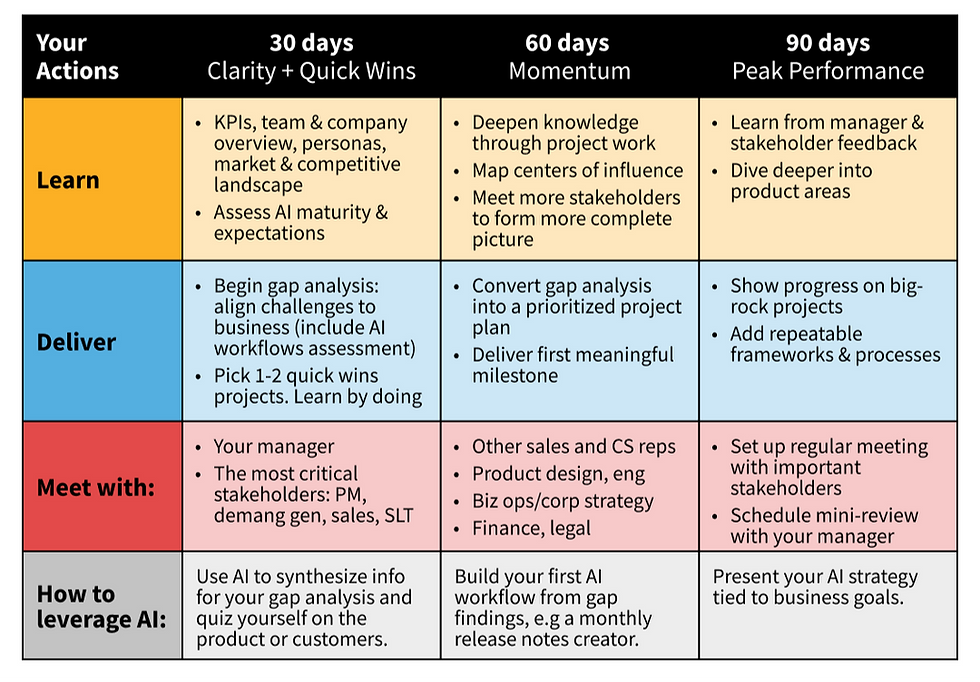
How to approach each project:

Use AI to become a better PMM: The AI PMM Academy
If this newsletter resonated with you, you're exactly who I'm building the AI PMM Academy for.
Every week, I talk to PMMs who know AI matters but feel overwhelmed by where to start. They're tired of the hype, tired of the fear-based messaging, and tired of generic AI advice that has nothing to do with product marketing.
They don't need another list of tools.
They need a practical way to combine strong PMM fundamentals with AI workflows that actually help them do better work.
That's what the AI PMM Academy is designed to do.
Together, we'll strengthen your core PMM skills like positioning, research, and product launch that works for today’s world, then layer AI on top in a way that actually makes sense for product marketing. We'll also focus on leadership, influence, and productivity so you can create more space for strategic work.
You'll learn alongside other PMMs navigating the same challenges, see real workflows from practitioners successfully using AI on the job, and build systems you can apply immediately in your own role.
This isn't a course full of talking-head videos and a certificate at the end. It's a hands-on learning program for PMMs who want to improve their craft, use AI thoughtfully, and grow alongside smart peers.
If that sounds like what you've been looking for, I'd love for you to join the waitlist and get early access when the program launches.
Yi Lin 💜
P.S. This newsletter was written human-first by me, edited by my amazing editor Christine Moore, and then proofread and polished with the help of AI.