How to nail your first 90 days as a PMM in 2026
Imagine you've just started a new product marketing role. Before you've even figured out where everything lives, your manager drops five things on you, all marked high priority:
Revamp all the product pages
Build a new sales pitch deck
Help the CSM team improve their QBR deck
Update the pricing page and revamp packaging
Lead the repositioning exercise, which leadership wanted yesterday
Where do you even begin? How do you tackle all of this without dropping the ball, or worse, accidentally burning a relationship you haven't even fully built yet?
These are the exact situations so many PMMs and new leaders face every day. And the thing is, most of us underestimate how critical the first 90 days really are, until we're in it.
That's why 2.5 years ago, I put together a framework I used to onboard successfully in my own career, one that helped me get promoted every single year in a new role. Since then, I've coached over 75 PMMs and leaders through this same process via my Grow onboarding program, and I've learned a lot along the way. Given the world we're operating in now, I've given this proven plan a little makeover: a framework optimized for an AI-enabled environment.
Before you groan inwardly (or outwardly) about "AI again", let me reassure you: this is a good thing. Because it's going to help you prove your worth more quickly. Like it or not, AI has changed the pace of product development. Product teams are now shipping in days what used to take weeks or months. As a result, PMMs are being asked to do more with less, get up to speed faster, and create more impact earlier in their tenure. The basic principles and activities are the same, but I have now added a layer that explicitly shows how you can use AI to accelerate what you’re learning and delivering, and made sure this plan works with the pace that hiring managers now demand.
So let's dive in.
The reframe that changes everything in your first 90 days as a PMM
Before you even start your first day, here's an important mindset shift you need to make:
Your first 90 days as a PMM are about reaching your break-even point, the moment when the value you're contributing to the business clearly exceeds the value you're consuming in time, training, and other people's attention (the line graph below).

In the beginning, it's completely natural and expected for that balance to tip toward consuming (the yellow part of the graph). You're new. You need context. That's fine. But your goal is to close that gap thoughtfully and cross it, so you move to the value delivery part (blue part of the graph).
When you do that, you can feel your manager relax, other team members start coming to you, and you stop feeling like you're playing catch-up, but that you actually belong there, because you do.
The secret the best PMMs have figured out is this: you don't cross that threshold by doing more. You cross it by doing the right things, in the right order, with the right people. Often, that means doing less than you think you should, so that what you do deliver is genuinely excellent and genuinely aligned.
To make that work, you need to be intentional about where you invest your time: what you learn, what you deliver, and who you spend time with.
Here’s how that plays out across three phases.
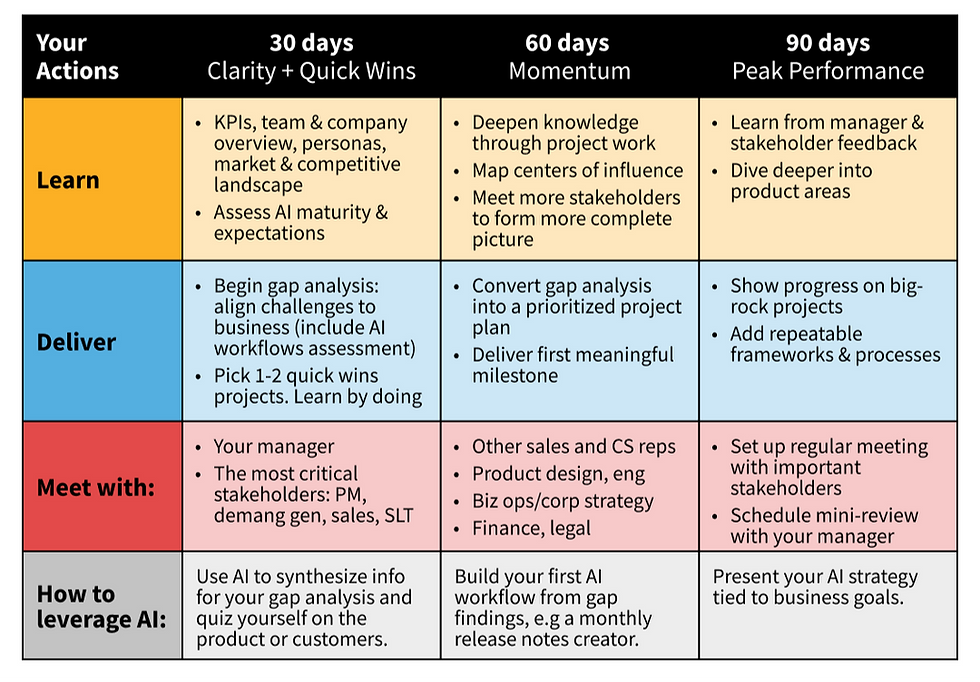
30 Days: Establish trust and credibility
Your main goal in the first 30 days is to make the right people feel heard, and to show, through a small number of well-chosen actions, that you understand what matters here.
What you need to learn: The most common trap I see is PMMs who spend their first month consuming everything – support docs, demo recordings, Gong calls – and end up feeling overwhelmed and unanchored. One client described it perfectly:
"I feel like I'm consuming so much, but I'm not actually absorbing anything."
The fix is simple but counterintuitive: learn by doing. Find a small project to dive into immediately before you feel ready. For example, you could take on a project to do competitive comparison pages, which will then force you to understand your product, your market, and your differentiation all at once, and you walk away with something actually useful.
What you need to deliver: Because you've been learning by doing, you're already partway toward your first wins. Pick 1–2 small but high-priority projects and execute them well. AI is your friend here: use it to synthesize call summaries, pull themes from release notes, and turn raw research into something usable faster than you ever could before. You’re not using it to replace your thinking, but to free up more of your time for the conversations that matter.
By the end of 30 days, everything you've learned and delivered should feed into one key output: your gap analysis, which is a clear, honest picture of where PMM is strong, where it's thin, and where the biggest opportunities are. This is the foundation that makes everything in the next phase strategic rather than reactive, and this is usually the place I spend time with my client building.
Who you should meet with: Your product managers, marketing leads, sales leadership, and your own manager. Go on a listening tour not to impress, but to understand. What does success look like from their seat? What are they worried about? Every one of these conversations is an investment that will pay off for months.
60 Days: Deliver larger wins, keep learning
By now, you have some early wins behind you and a gap analysis in hand. In the next 30 days, you're moving from listening to doing. You've earned enough context to have a real point of view, and people are starting to see it.
What you need to learn: Go deeper on customers. Shadow sales calls. Sit with CS. Your first 30 days gave you the foundations and now is when you learn how customers actually experience the product day-to-day: what makes them stay, what makes them leave, what keeps coming up in deals. This is also when you start mapping who really holds influence in your org, not just by title, but by internal trust. Every team has someone whose opinion others look up to. Find that person early and invest in that relationship.
What you need to deliver: Turn your gap analysis into a prioritized project plan you can share with your manager and stakeholders. It should answer the question everyone is really asking: what are you working on, and why does it matter to me? If you’re in a founding PMM role where the function isn’t well understood, start by aligning on what PMM is meant to drive, and tie it directly to their goals, not yours.
This is also a great phase to start building AI-powered workflows that support your bigger projects. Start with the problem to understand where time is being lost, and where AI could help. Show your work as you go, and invite people in before things are finished.
Who you should meet with: Sales reps and CS for richer customer and prospect insights. Product design and engineering to understand the roadmap more deeply. And of course, any additional centers of influence you've identified.
90 Days: Ramp up for peak performance
This is the phase where it all starts to come together. The focus shifts from building context and racking up early wins to showing that your work is creating real, measurable impact, and you cross the break-even threshold.
What you need to learn: At this stage, your most valuable learning comes from feedback on your deliverables, your priorities, and how you're showing up as a partner to other teams. Pay close attention to what's landing and what isn't. This is the phase where your self-awareness compounds fastest.
What you need to deliver: Show real progress on your most important project. It doesn't have to be finished as sharing work in progress and inviting input is often more valuable than waiting until something is perfect. Socialize what you've already shipped too: what changed, what the impact was, what you learned. This is especially important for solo PMMs who are still helping their organization understand what product marketing does and why it matters.
On the AI front, this is a great time to formalize what you've been building and present a simple AI strategy to your manager and team, something you can fold into the broader team plan going forward. I'd suggest framing it as a crawl, walk, run approach: here's where we started, here's where we are, here's where we're headed.
Who you should meet with: Key stakeholders to share your results and map out what's next. This is also the moment to schedule a 90-day check-in with your manager separate from your regular 1:1. Use a simple start, stop, continue framework: what should you keep doing, stop doing, and start doing? It removes the pressure of a formal review and gets you more immediately useful feedback than almost any other conversation you'll have.
And start establishing the recurring rhythms that will define how you operate going forward, with your manager, and with the product, sales, and CS partners whose work intersects most with yours. These relationships are the infrastructure of everything you'll build from here.
What's next?
The framework above will take you a long way to go through your first 90 days with intention. But I also know from experience that knowing what to do and applying it to your specific situation, your company, your manager, and your team dynamics are two different things. That's where having someone in your corner makes a real difference, especially if you're navigating a transition like:
Moving from a large company to a startup, or vice versa
Stepping into a new industry without the domain shorthand yet
Taking on a leadership role for the first time (e.g., director, head of roles)
Coming in as a solo PMM with no playbook to inherit
Here's what a couple of people said after working through this with me:
"Yi Lin gave me a clear, actionable roadmap that helped me quickly build relationships and impress my leadership team from day one. Within six months, I received an award for my contributions, something I never expected so early on." — Terver Bendega, Sr. PMM, Tipalti
"Working with Yi Lin has been like product marketing therapy; she's not just an expert, she's a true partner." — Emily Highstreet, Head of Marketing, RevenueRoll
If any of this resonated, I'd love to hear from you. Reply to this email and tell me, what's the one thing you're most hoping to get right in a new role right now? I read everything personally and always write back.
And if you'd like a guide beside you for the whole journey, learn more about the GROW program here.
Before you leave, one more thing:
Come meet me in person this month!
If you have ever wondered what working with me is like (or if I am real 😄 ), I will be hosting two small, off-the-record PMM dinners in New York and San Francisco this month! No agenda, no pitch, just real conversation with a handful of mid-career PMMs navigating real transitions. Think of it as a supper club for the stuff we don't usually say out loud.
New York (Manhattan): May 17th
San Francisco: May 27th
If you’d like to join any of the dinners above, just reply to this email, share a bit about yourself, and grab a spot. :) I would love to meet you!

Until next month, Yi Lin 💜
