The Thriving PMM Framework: How to Build an Intentional PMM Career
Before we dive into the main content, here is a quick announcement!
If you’re a PMM stuck in your job search and tired of rejections, this is for you. I’m opening the next enrollment window for my PMM Job Search System from April 13–17.
4 reasons to join this program:
1:1 time with me. You get a focused 30-min session to tackle your most critical blocker
A proven, end-to-end playbook with 9 modules and 30 lessons built specifically for PMMs
Live workshops led by me, covering everything from resumes, interviews, case assignments, and even AI fluency
A 300+ PMM private network, with alumni inside hiring teams and companies you want to work at
On average, at least one member per week from the program is landing a job right now. If you’re serious about landing your next role, don’t miss this opportunity. :)
Now let's dive in.
The question underneath all the noise
Every week, I get some version of the same message.
A PMM who is accomplished, capable, and clearly good at their work reaches out, wondering if they are building the right career for what’s coming next. Sometimes it’s driven by AI. Sometimes it’s a role that no longer feels like a fit. And sometimes it’s more vague, like a sense of being stuck or off track.
Underneath all of it, the question is almost always the same.
Am I actually in control of where this is going? And if I’m not, how can I be?
When that question starts to surface, it is very natural to narrow your focus too quickly and look for answers in what feels most visible, urgent, or widely talked about. It creates a sense of direction, or at least the feeling of doing something productive.
But this is usually where things start heading in the wrong direction.
Because you might begin making decisions that are not fully aligned with where you actually want to go, or you might optimize for what seems important in the moment, rather than what will meaningfully move you forward. Over time, that gap compounds. You can put a ton of effort into solving problems that don’t change your trajectory, and end up feeling more stuck because of it.
I see this often in how PMMs respond to shifts like AI. There is a tendency to double down on tools or tactics when trying to address a deeper question about career direction, only leading to more frustrations and feelings of FOMO, or straight-up fear.
The PMMs who navigate through changes successfully approach this differently. They are not the ones chasing the newest or most talked-about trends. Instead, they’re the ones who have enough clarity about themselves to make intentional choices as their environment shifts.
This is a pattern I have seen consistently across the 300+ PMMs and leaders I have coached, regardless of company, level, or market conditions. It is also what led me to develop the Thriving PMM Framework.
The framework is a way to think more systematically about how you build your PMM career. It has three layers:
Layer 1 focuses on PMM craft, the core skills that define the role, which are now increasingly augmented by AI.
Layer 2 is about human skills, the capabilities that carry across contexts and are not easily replicated by tools.
Layer 3, which sits at the foundation, is your career agency. This is your ability to define your path, shape your story, and navigate key inflection points with intention.
Today, I’ll walk through each of these three layers to help you get clearer on where you are and what actually matters next.
Let’s dig in.

Layer 1: The core PMM skills
Let’s start with the first layer, PMM craft, because this is where most of the noise is right now.
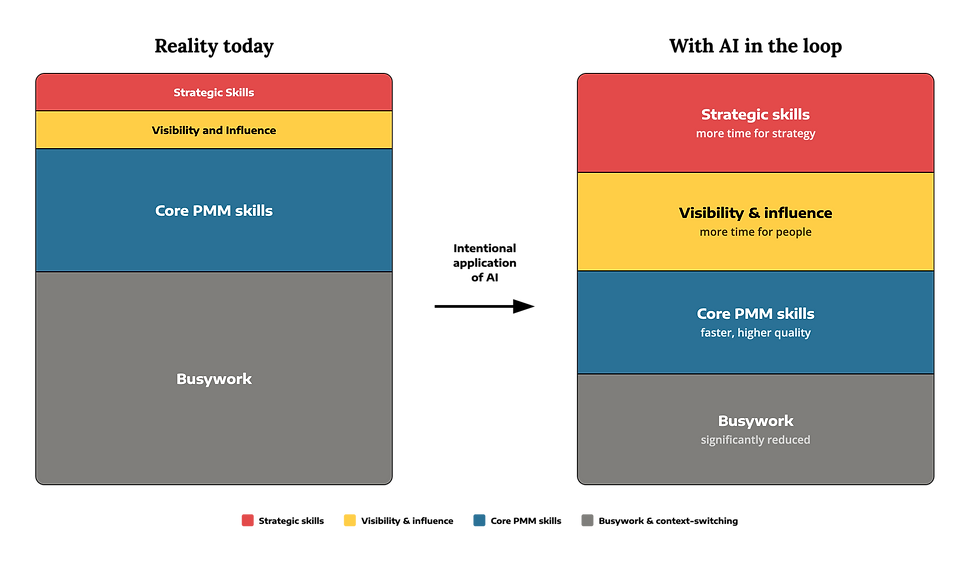
First, let me reassure you. The core PMM craft isn’t going away. If anything, AI is raising the bar for quality, which means the fundamentals matter more than ever. In fact, from what I’m seeing in my own advisory work, demand for positioning and messaging has actually increased, not decreased.
What is changing is how the role shows up. AI is pushing PMMs further into orchestrator roles, where you are coordinating work to improve efficiency while keeping the strategy intact.
To use music as an analogy, as the conductor of an orchestra, you are not playing every instrument yourself, but you are responsible for how it all comes together. That requires a strong understanding of what each instrument can do and how to bring them together in a way that actually works. Ultimately, that is what determines the quality of the performance, and is what separates great world-class philharmonics from the rest.
So what are the core elements of the PMM craft? Here is a refresher on the four foundational elements:
Research. Deep competitive, market, and customer research. The insights that move strategy. AI can synthesize faster, but you still need to make judgment about what to pay attention to and what’s just noise.
Positioning and messaging. Turning insights into a clear narrative that resonates. AI can generate options, but you need to shape what’s actually true and differentiated that doesn’t sound like everyone else.
GTM systems. Building the operating model for launches, campaigns, and go-to-market strategy. AI helps with execution; you still need to design the architecture, often in collaboration with other humans.
Enablement and evangelism. Making sure the message lands internally with sales and externally with the market. AI can help with content; but again, the relationships and influence are human.
Of course, these don’t cover every responsibility a product marketer might have. The scope will vary depending on company stage, size, and go-to-market motion. Some PMMs will own pricing and packaging, while others focus on analyst relations or even in-product activation. But these four areas form a core foundation. Without them, it is difficult to build real strength in the role.
In summary, the right way to approach AI is to treat it as an execution accelerator across all the core PMM craft elements. It increases the speed and volume of work, making judgment and prioritization even more important. The table below breaks this down more concretely across human-led, AI-assisted, and AI-driven work.
Table: How PMM work shifts across human judgment and AI support (not exhaustive)

👉 If you want to go deeper on how to use AI in your daily work, check out my comprehensive State of AI in Product Marketing Report.
Layer 2: The human skills no tool can replace
If Layer 1 is about the work itself, Layer 2 is about how that work actually gets done.
I was recently talking with a Lead PMM at a large tech company who was hired to own her company’s platform AI narrative. Her role is entirely centered on AI. But when I asked what actually makes her successful, she didn’t mention tools or technical depth. She said it was her ability to build relationships, align teams, and get people to believe in what they’re building.
The irony wasn’t lost on either of us. The most important skill of an AI PMM is, in fact, irreducibly human.
Here are the two skills that are fundamental to being a great PMM that AI simply cannot replace:
Influence and relationships. This is one of those areas that can sound almost cliché, as “Influence without authority” gets talked about a lot. But in practice, it is still one of the most important skills to get right. Influence is your ability to build trust across all stakeholders, such as product, sales, leadership, and customers. It shows up internally, in how you align teams and drive decisions, and externally, in how your message lands in the market. It also requires judgment, e.g., knowing which battles to pick, when to push, and how to bring people along. Because let’s face it, this is what determines whether your work actually gets implemented and seen.
👉 If you want to go deeper on this, I’ve written an entire newsletter on this topic that you can check out here
Business strategy. This has always been critical for PMMs, but it is now more important than ever. Because as AI takes on more execution, the work becomes even more about deciding what is worth doing in the first place, and why… and that is business strategy. You need to understand how the business operates, connect your work to revenue, growth, and company priorities, and prioritize ruthlessly and communicate trade-offs to leadership. This is what separates strategic PMMs from tactical ones: the ability to work one hour with product management, hop on a customer call with CX, and then present a deep dive on the competition to the leadership team, all while thinking about the business as a whole, and not just that particular piece of it.
👉 If you want to go deeper on how to connect PMM work to business strategy and growth, I’ve written more about that here
The bottom line is, PMM is a connector role between many different functions, and success depends on navigating people as much as it does on producing work. It requires emotional intelligence, judgment, and a strong understanding of how the business operates, along with the ability to align across different priorities.
None of that can be automated.
The image below shows how the PMM role works in practice, not as the center of teams, but as the connector across them.

Layer 3: Career agency as the foundation
If Layer 1 is about the work itself, and Layer 2 is about how that work gets done, then Layer 3 is about the direction you’re actually heading in.
This is the layer most PMMs don’t spend enough time on, but it is the one that makes everything else work.
There’s a chart I often share when I give a talk about PMM career design at conferences:

Most people who see this focus on the winding parts, aka “my second act”: the startup that failed, the art business, the pivot into product marketing, etc.
What they don’t always notice is what the straight line (blue area) at the beginning actually represents.
That was me with low career agency. I was an engineering consultant out of Georgia Tech, moving predictably upward, but unhappy. Even though I knew early on I didn’t want to be a consultant, I stayed for 6 years anyway, mostly out of fear and uncertainty.
What changed wasn’t that I suddenly had a perfect plan. It was that I started treating my career as something I was actively designing, rather than something that was happening to me.
Once that shifted, the path became more nonlinear, but also more intentional.
The startup that didn’t work, the stint in content marketing, the art business, they stopped feeling like detours. Each one gave me information and shaped what I did next.
And over time, that led to outcomes that would have been very difficult to plan up front. i.e., moving to PMM, being promoted three times in three years to Director, building teams from scratch, and eventually creating a portfolio career that spans coaching, advising, and my art business (and living perhaps the most fulfilling phase of my career)
If you’re curious, I once wrote a “resume of failure” that captures a lot of these pivots and detours.
I share this because it’s what career agency actually looks like in practice. I also share this to show you that no matter where you are at one point, you can change it and take control of it.
Career agency is not just about having skills. It’s about being the primary driver of your own career, making decisions even when it’s hard, evaluating trade-offs, and moving in a direction that aligns with what you actually want.
In practical terms, career agency consists of skills that empower you to do the following:
Path design: Getting clear on where you actually want to go, whether that’s leadership, a deeper IC path, a portfolio career, or something you can’t quite name yet. There’s no right answer because it’s about you, and your unique journey.
Landing the right role: Knowing how to articulate your value clearly, finding roles genuinely aligned with that, and finding a role that maximizes growth and what you value instead of settling for any offer that comes along (or other people’s definition of good).
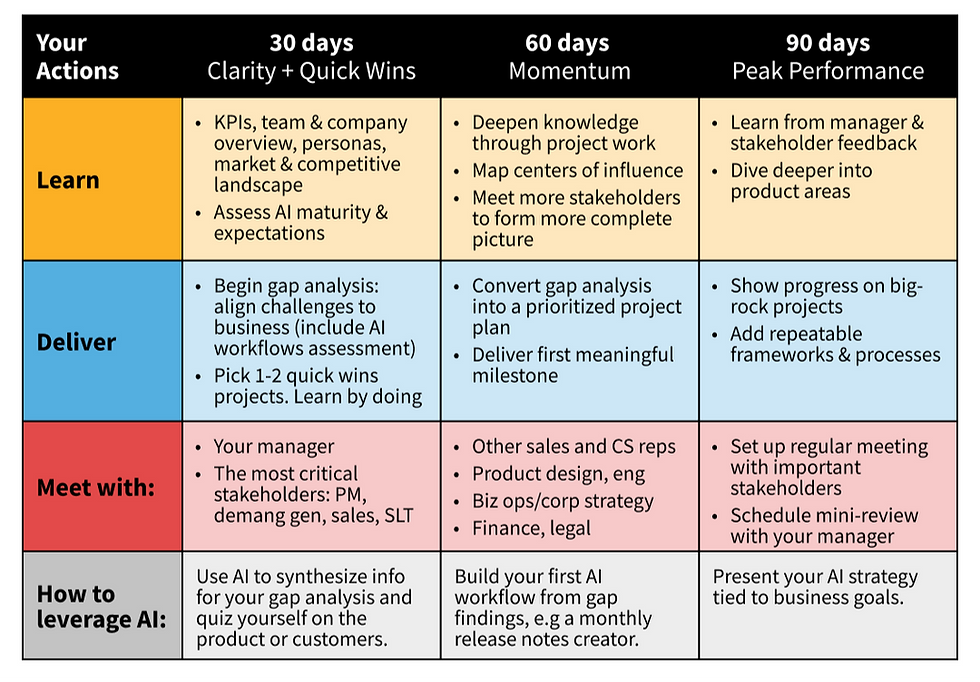
Thriving once you’re in it: Having a real playbook for the first 90 days, knowing how to position yourself for promotion, and building the internal relationships that actually move your career.
Building optionality: Designing a career that goes beyond the current job, which includes your personal brand, your network, and the reputation you’re building in the market. This is the work you do for yourself, not just for a company’s roadmap.
To give you an example, one of my clients came into our first session and said, “I don’t even know what my career goal is.” So we actually spent that first session just clarifying that. And what she realized was that she didn’t want to be a full-time PMM anymore. She wanted to build her own business.
From there, we spent the rest of the program building out her business idea, her offer, and her entire GTM strategy, including how she would test and get her first clients.
Within two months of launching, she had already signed a major client.
That’s what I mean by career agency. Because it doesn’t matter how strong your skills are or what others perceive as success. If you don’t know where you’re going or are just following others’ playbooks, you can end up just rowing harder in the wrong direction.
That’s why this layer sits at the foundation of everything else.
What’s next - Start building your PMM career with intention
If you’re reading this and it’s making you think more seriously about your own direction, this is the work I do and have been doing.
I’ve worked with experienced PMMs across different stages, whether they’re trying to land a new role, get promoted, or figure out a bigger shift in their career. But I also know that when you’re at that point, you might not even know what the right next step is, or which program makes sense.
That’s why I am offering a limited, one-time Career Clarity Session.
This is a focused session where we look at where you are today, assess what’s actually going on across these different layers, and help you get clear on what your next move should be.
This is a good fit if you’re a mid-career PMM:
thinking about a new role or promotion
feeling stuck in your current role
or trying to figure out where your career is actually going
This offer is valid only for the next 2 weeks.
And if you’re wondering what this looks like in practice, here are a few experiences from PMMs I’ve worked with:

That’s all for today! See you next time.
Yi Lin