
AI is making research easier, but are PMMs getting better insights?
In September, I kicked off the first cohort of the AI PMM Academy, where I’m working with ten experienced PMMs and leaders to apply AI to their actual work.
As I went through every participant’s intake exercises, two themes jumped out. Nearly everyone wanted to find a better way to capture recurring buyer insights from sales and customer calls, or to track competitive intelligence without spending hours gathering updates.
That makes perfect sense. We finally have tools that can process hundreds of transcripts, search competitor websites, and generate polished research reports in a fraction of the time.
But here’s the catch: being able to produce a research report faster doesn’t necessarily mean you’re producing better research.
You can upload 200 sales call recordings into Claude and get back a convincing list of pain points, themes, and recommendations. But how do you know whether those patterns are real, whether the evidence is valid, or what the business should do with it?
That’s why, in session 4 of our AI PMM Academy, I kept coming back to two separate questions:
How do you design good research in the first place?
And then, how do you turn the right parts of that research into useful AI workflows?
I’ve also put together a free PMM AI Research Toolkit so you can apply this to your own work. More on that below, but first, let’s cover some important fundamentals.
Research is the foundation of great product marketing
Research is the foundation of great product marketing because it powers everything downstream.
Strong research helps you uncover meaningful customer and market insights, which inform how you position your product, differentiate it from competitors, and communicate its value. That positioning then becomes the foundation for compelling messaging and narratives that power your go-to-market activities, from product launches and sales enablement to campaigns and content creation.
This is also what makes product marketers truly strategic and valuable. When you bring new insights to the table, you’re not just executing requests or creating assets. You’re helping the business understand its customers, make better decisions, and identify opportunities for growth. Without those insights, it’s easy to become a tactical execution machine.
This is why I generally organize core PMM work into three interconnected pillars:
Research and insights: Understand your customers, competitors, and market.
Positioning and messaging: Turn those insights into a differentiated strategy and compelling narrative.
Go-to-market execution: Bring that strategy to life through launches, sales enablement, campaigns, and other activities.
And it’s not a one-way process. What you learn from your go-to-market execution feeds back into research, creating a continuous cycle of learning, refinement, and improvement.
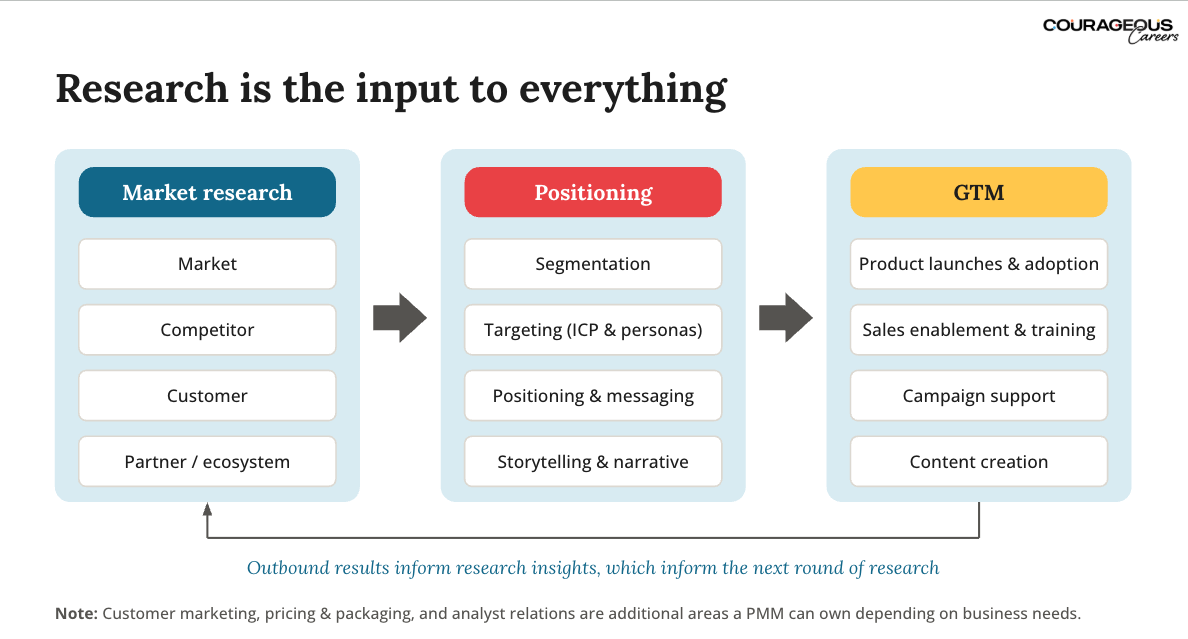
Research isn’t just one activity, either. Customer research helps you understand what buyers say, choose, and do. Competitive research helps you understand their alternatives. Market research helps you understand the broader category and where it’s heading. Each needs different evidence and methods.
In fact, I’ve mapped out 21 different research tactics that PMMs can use, along with the questions they help answer and where AI can play a role. You certainly don’t need to use all of them, but knowing what’s available helps you choose the right approach for the problem you’re trying to solve.
The full matrix is in my free PMM AI Research Toolkit below.
So where does AI come in?
Of course, conducting good research takes time. Depending on what you’re trying to learn, you might need to interview customers, analyze sales conversations, investigate competitors, or pull together information from multiple sources.
And this is where AI presents an enormous opportunity.
Work that used to take days or weeks can now happen much faster. We can process hundreds of customer conversations, monitor competitor developments, and organize large amounts of information with far less manual effort.
But there’s a catch.
When it’s so easy to upload a dataset and generate a polished report, it’s tempting to skip the research design altogether.
Which brings me to one of the most important research principles I teach.
Start with the problem, not the dataset
A common starting point when PMMs experiment with AI for research is the data they already have.
For instance:
“I have 200 Gong calls. What can I do with them?”
I get the temptation. You finally have access to all this information, and AI makes it incredibly easy to analyze.
But having a dataset isn’t the same as having a research question.
Imagine that your sales win rate dropped last quarter. The real question isn’t “What themes can AI find in our calls?”
It might be “Why are we losing more qualified deals, and what should we investigate or change to improve performance?”
Maybe the decline is concentrated in one segment. Maybe a competitor repositioned. Maybe the problem is messaging, pricing, targeting, or the sales process. Each of these possibilities could require different research methods and data sources.
This is why I recommend PMMs use the backwards research method.
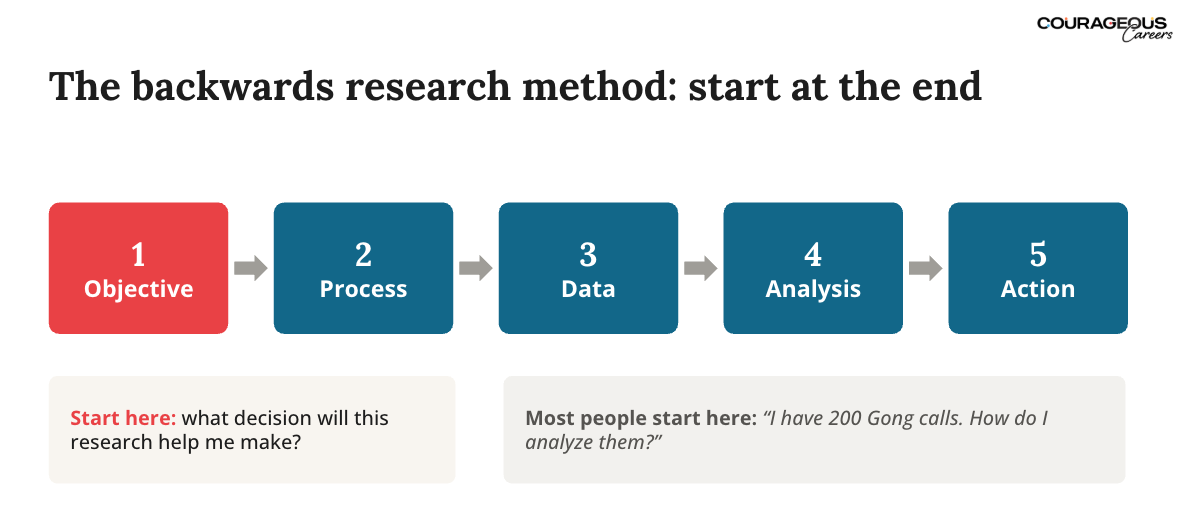
Rather than jumping straight into collecting and analyzing data, start by defining your objective and the business decision you’re trying to inform. Then design the process to investigate that question, identify the evidence you need, analyze the findings, and decide what to do next.
It sounds straightforward, but it’s easy to forget these steps when you’re under pressure to produce something quickly.
We saw two great examples of this in our AI PMM Academy research session:
Andrea Saez, PMM lead at n8n and our guest mentor, shared a competitive intelligence tracker built to answer a specific question: Which competitor moves actually matter to her business? Rather than collecting updates for another report, her workflow starts with her company’s positioning, ICP, messaging, and pricing. It then tracks changes over time and produces a sourced report highlighting potential risks. Andrea reviews the findings and decides what, if anything, to act on.
Michael Hetrick, Director of PMM and one of our mentors, took a different approach. He demonstrated an AI skill that crawls competitors’ websites very accurately to examine their positioning and messaging, helping him compare how competitors describe their products and identify gaps or changes worth investigating.
Both are doing competitive research, but for different business needs. That’s the point of the backwards research method: start with the question or problem you’re trying to answer, then design the research and AI workflow around it.
New free resource: The PMM AI Research Toolkit
Knowing the right way to think about research is one thing. Choosing the right methods, setting up the data, and building an AI workflow you can trust is another.
That’s why I created the PMM AI Research Toolkit. It includes:
A complete research guide to designing useful research and identifying where AI can help (an expanded version of this post).
A Research Tactics Matrix with 21 research methods, the questions they answer, and the role AI can play.
A reusable Call Research Guide skill that can work with Claude or ChatGPT for analyzing sales and customer calls from Gong, Fathom, or similar tools.
A few additional principles for conducting better research with AI
Finally, even with the right objective, the quality of your results depends on how you set up the research. Here are a few principles I always encourage PMMs to follow:
Control your inputs. Be intentional about what data you include. If you’re analyzing sales calls, for example, pay attention to the customer segment, sales stage, and time period, and clarify them as much as needed. Throwing everything into one dataset can produce misleading patterns.
Define your requirements before building. Specify what you’re investigating, which sources you need, and what you want the output to look like. Even a short requirements document can make your AI workflow much more effective.
Validate your findings. Don’t accept AI-generated summaries at face value. Check the original evidence, verify quotes and sources, and test whether the patterns you identified hold up in additional data.
Triangulate your research. Use multiple sources of evidence to validate findings and identify contradictions. One dataset rarely tells you the whole story.
I want to double-click on the last point because it’s one of my favorite research principles, and one I don’t think PMMs use nearly enough.
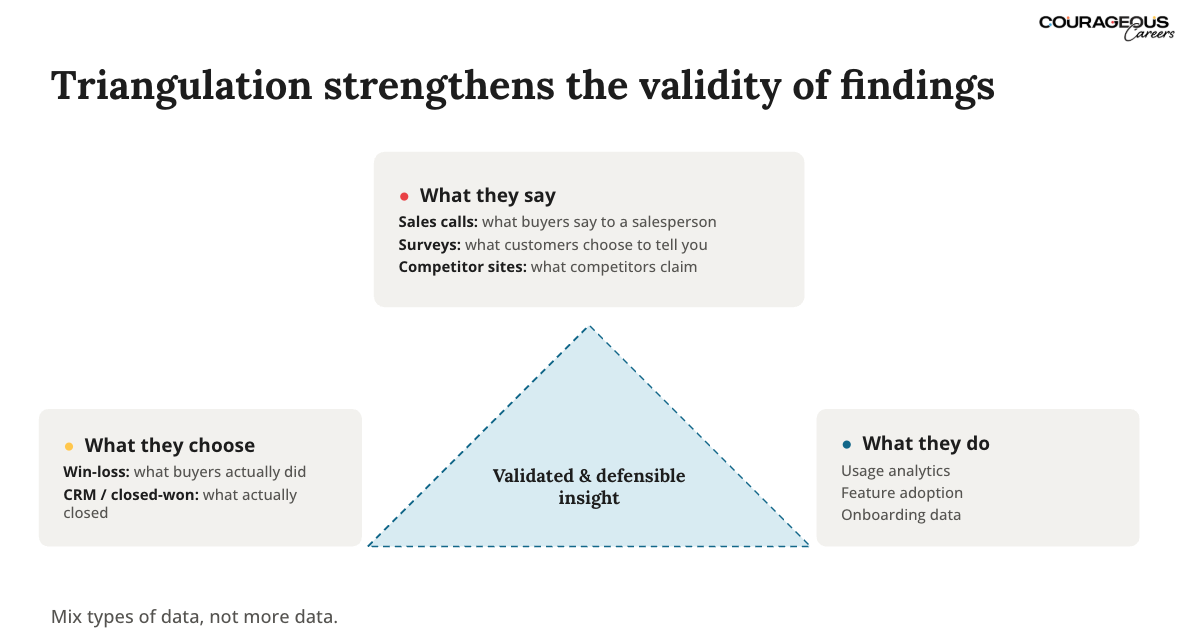
Triangulation: Look at what customers say, choose, and do
In research, triangulation simply means examining a question from multiple angles.
For product marketers, I generally think about three types of evidence:
What customers say: Interviews, surveys, customer conversations, and sales call recordings.
What customers choose: Win/loss data, CRM records, and actual purchasing decisions.
What customers do: Product usage, feature adoption, onboarding behavior, and other behavioral data.
Why does this matter?
Let’s say your research finds that customers frequently complain about pricing during sales calls.
Does that mean your product is too expensive?
Not necessarily.
You might find that many of those customers still purchased your product. Or that customers who chose a competitor actually did so because of missing capabilities rather than price.
Looking at these different sources helps you understand what might really be happening, rather than jumping to conclusions based on one type of evidence.
Natalie Marcotullio, who leads product marketing at Navattic and is one of our Academy mentors, shared a great example of this. When developing positioning for a new product, her team combined three data sources:
Internal sales conversations
Early customer and user insights
External buyer research from GetWhys to validate their assumptions
That’s exactly what strong research should accomplish.
The takeaway: AI can help you analyze evidence much faster, but it’s still your job to make sure the evidence is relevant, reliable, and sufficient to support your conclusions.
Becoming a better PMM and leader in the age of AI
If this post has given you a few new ideas about how to approach research, that’s amazing! But research is just one part of product marketing.
The bigger opportunity is learning how to think through business problems, design the right approach, and then use AI to execute more effectively across every aspect of product marketing, from positioning and messaging to GTM launches, enablement, content, and more.
That’s exactly what we’re doing in the AI PMM Academy. We’re learning how to approach real PMM problems, design effective workflows, and build the context systems, skills, and agents to execute them. And most importantly, we’re learning by doing, testing these workflows on real projects and getting feedback from experienced mentors and peers.
As our first cohort wraps up, I wanted to share a small piece of what we’ve been learning with the broader PMM community.
So grab the free PMM AI Research Toolkit, try out the skills on your own research projects, and see what you discover!
And please, reach out and tell me how it goes. I’d genuinely love to hear what you tried, what worked (or didn’t!), and what you learned along the way.
Get the free PMM AI Research Toolkit →
You’ve got this!
Yi Lin
