Is AI making you sweat?
You’ve been given an AI mandate. Maybe you are new to leadership. Maybe you’ve just stepped into a new role. Or maybe you’ve simply been handed the responsibility without much direction.
Either way, the expectation is clear: “figure out how AI makes us more productive.”
Translation: multiply yourself (and your team).
The challenge is knowing where to start. While there’s no shortage of well-meaning AI tool lists, webinars, and prompts lists out there, they rarely cover what matters most: the strategy to design and implement a real product marketing-focused workflow. To see real results, you need clarity on your goals, a focused place to begin, and alignment with leadership.
When I published the State of AI in Product Marketing Report, I highlighted how PMMs are using AI. Since then, the biggest question I’ve heard is: “Okay, but how do you actually execute this in real life?”
That’s what this post is about: building real workflows, so you can use AI in a way that makes you more strategic, not just busier. And I’ve got a cool real-life example at the end - so don’t scroll away too soon!
Why AI adoptions fail
Before we dive into how to build an AI flow the right way, it’s worth asking: why do so many attempts fail? An MIT study recently found that 95% of enterprise AI pilots never scale or deliver ROI (source). While that study focused on big enterprises, the same traps show up in startups and even small teams. Three themes kept coming up in my advising and coaching work:
Unclear objectives → AI projects were launched just to “keep up,” with no defined problem or success metric.
Lack of change management/guardrail → everyone experiments in isolation, but no one sets ownership, process, or guardrails.
Skill gaps → teams jump in without expertise in the very workflows they are building, leading to shallow adoption or lower quality outputs.
When you zoom out, you realize the problem isn’t a lack of enthusiasm; it’s the absence of structure. Most organizations (especially startups) treat AI as a quick productivity hack, not a business capability that deserves real design.
How to build Product Marketing AI workflows the right way
So what do the successful 5% do differently? They treat AI as a system, not a shortcut. For PMMs and team leads, that means resisting the hype, slowing down, and being intentional. Here’s how I advise my clients to do it:
1. Anchor to a business goal
Start with strategy. Not “what can AI do?” but what does the business need right now?
For example, if win rates are dropping because competitors keep undercutting you, your AI pilots should directly address bottom-of-funnel conversion.
2. Choose a focused use case
Once the goal is clear, pick one workflow that maps directly to it. The mistake I see often is starting too broadly. “Product launch,” for example, isn’t a single use case; it’s five or six (research review, positioning, promo plan, enablement, content). No wonder teams get stuck.
So how do you choose the right one? I keep two simple principles in mind:
Small enough to solve, big enough to matter (credit to Zapier).
Start with more execution-focused tasks (left of the spectrum of the graphic below): this is where AI has the biggest advantage.
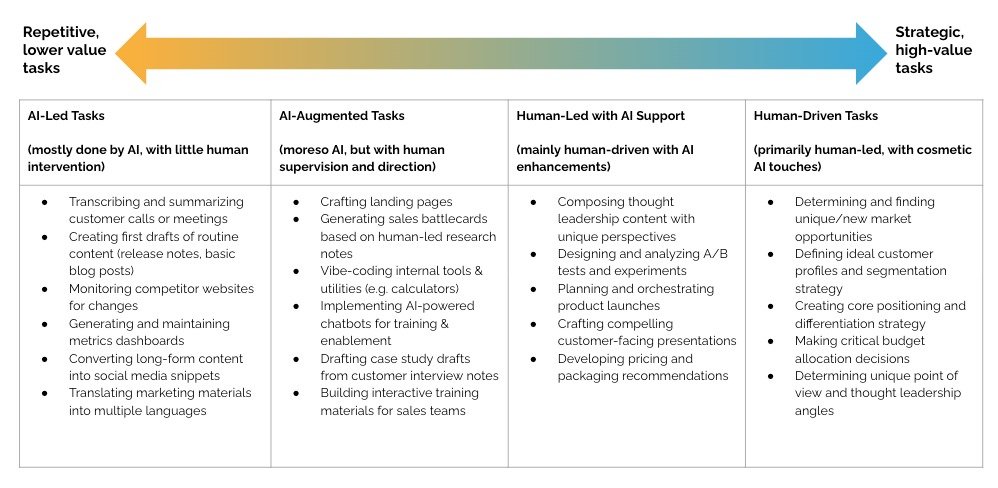
The temptation is to begin with things like positioning, the “big ticket” work. But those require the most human judgment (and a ton of stakeholder alignment). They are the easiest place for AI to fail. Start small on the left, prove value, then expand.
👉 Example: if competitive intel is the challenge, begin with an AI-assisted workflow that aggregates competitor updates for a single top competitor. Document the process, capture the win, and build from there.
Don’t get hung up on the format. It doesn’t matter whether that first use case is just a few saved prompts, a lightweight custom GPT, or eventually an agent (yes, agents are cool, but no, you absolutely don’t need one from the beginning). What matters is that it’s tied to your business goal and scoped small enough to deliver a win.
3. Define what “good” looks like
Before writing a single prompt, map the structure of a high-quality output. For instance, if you are creating a competitive landing page, define the essential elements first: headline, proof point, differentiator, and CTA. Don’t rely on the tool you’re using to shape what good looks like.
Feed it the right inputs: battlecards, customer stories, landing page examples, brand guidelines. That’s when AI starts to feel like an extension of the team instead of random internet text or AI slop.
4. Build in public, share, and iterate
As you are building your workflow, document wins, refine prompts, and expand step by step. One client started with AI call summaries, then layered in objection handling, and only later tackled messaging. Each stage built credibility and confidence.
Despite any “expert advice” you see, the fact is: AI is new for everyone. No one has the playbook figured out. The PMMs and team who win are the ones who share what they are building. Post your workflows, host a quick demo at all-hands, or create a shared prompt library. This not only builds momentum but positions you as the AI champion in your org.
Pro tip: bake your process into the workflow itself. Include usage notes, dos and don’ts, and review loops so the system is as much about guidelines as it is about outputs.
Case study: The landing page that built itself (almost)
To bring this process to life, let me share a real example from a founding PMM client (with his permission, of course). His small team was spending weeks writing and re-writing landing pages, with unclear ownership and inconsistent quality.
So he built an AI flow that blended automation with human strategy, which results in not just faster output, but better output.
The project at hand was a product landing page positioned against a major competitor (a legacy system), tailored for a specific persona. It wasn’t about creating new positioning or messaging (that work was already done, and remember, that’s a “right side of the spectrum” task). The challenge was translating existing messaging into landing page copy using a repeatable, proven framework.
I helped him think through the backend strategy that made this workflow scalable. Here’s how we broke it down (which roughly mirrors the steps above). It all comes back to what I said at the beginning: start with strategy.
1. Anchor to a business goal
Before writing a single prompt, we clarified the business outcome. The team’s priority was improving middle-of-funnel conversion, getting more prospects to book demos.
2. Scope the right use case
From there, we explored different ideas. After discussing a few, we landed on the use case of building high-converting competitive landing pages.
This is because expanding to all webpages would have diluted the model and produced inconsistent outputs. Competitive landing pages, on the other hand, were:
Directly tied to demo bookings → a measurable outcome the business cared about.
Straightforward → easy to define what “good” looked like.
Self-contained → mostly owned by marketing, which reduced dependencies and made it faster to implement.
By starting here, we set the project up for a fast, credible win that built confidence and momentum.
3. Research, codify, and feed the tool with best practices.
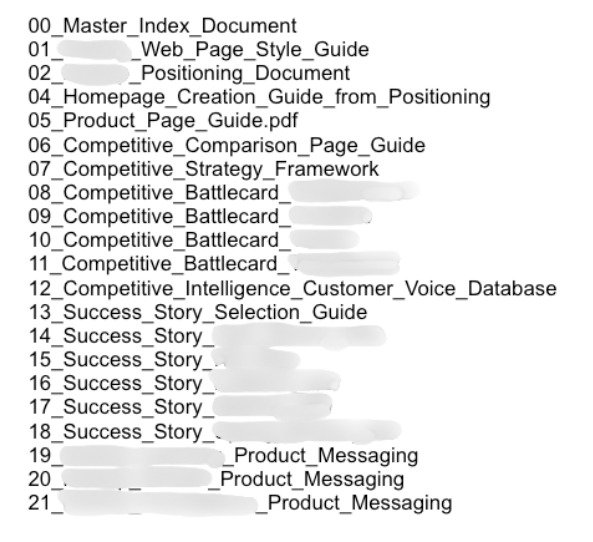
Rather than relying on guesswork, my client and I pulled from industry frameworks, my own experience advising PMM teams, and examples of top-performing landing pages. He then fed these, along with other critical information, to Claude. It included artifacts like:
Product and positioning guides
Competitive battlecards
Strategy frameworks
Success stories and customer-voice databases
Style and messaging guidelines
And that’s the great news: odds are, you have all of this (and more!) already. Each of these assets taught the AI how the brand thinks, writes, and differentiates. This is what made it more than a generic content generator and instead an extension of the team’s expertise.
4. Layer in collaboration, guardrails, and share
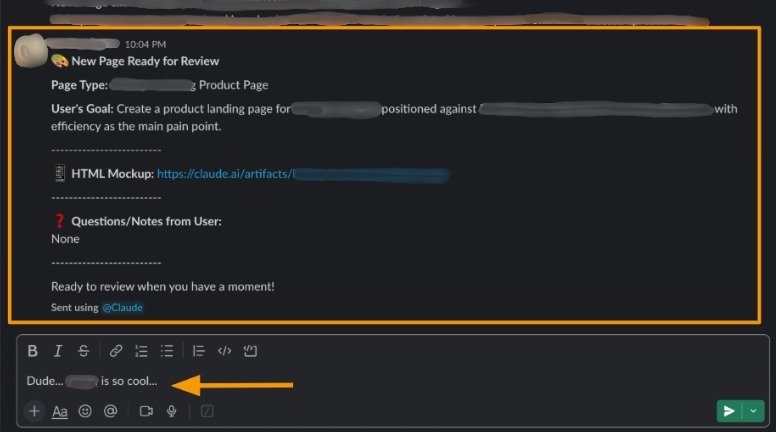
From there, the workflow was built with guardrails: it asked clarifying questions before generating anything, cited sources for every claim, and routed outputs through review loops. This way, you are not just generating good output but modeling the right review process and workflow.
For example, here’s a screenshot of an automated Slack message created using an MCP connector (a new open standard that lets AI connect securely to tools like Slack, Notion, or Google Drive). Whenever someone on the marketing team publishes a new page, the system instantly notifies the PMM and routes it for review.
So, how does the workflow look in action?
From the user side, it’s NOT just a one-and-done prompt. The system is built with guided steps that prompt the user for additional information, e.g. different styles of messaging for the headline from a pre-set number of options.
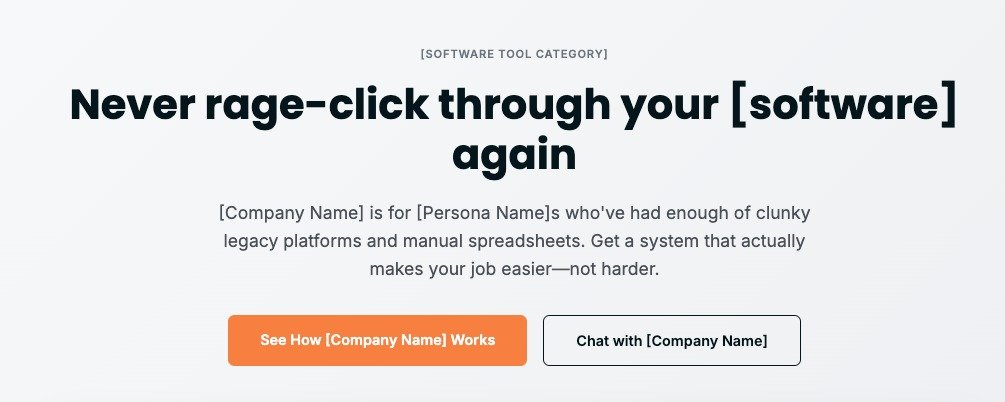
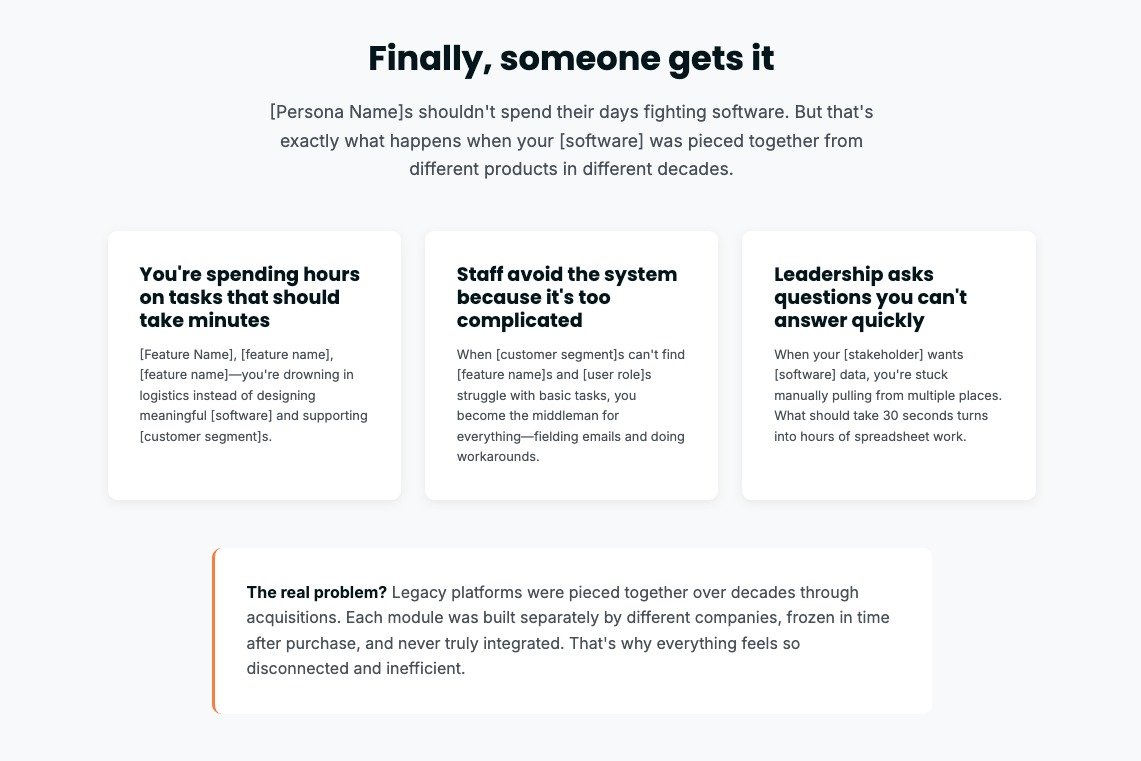
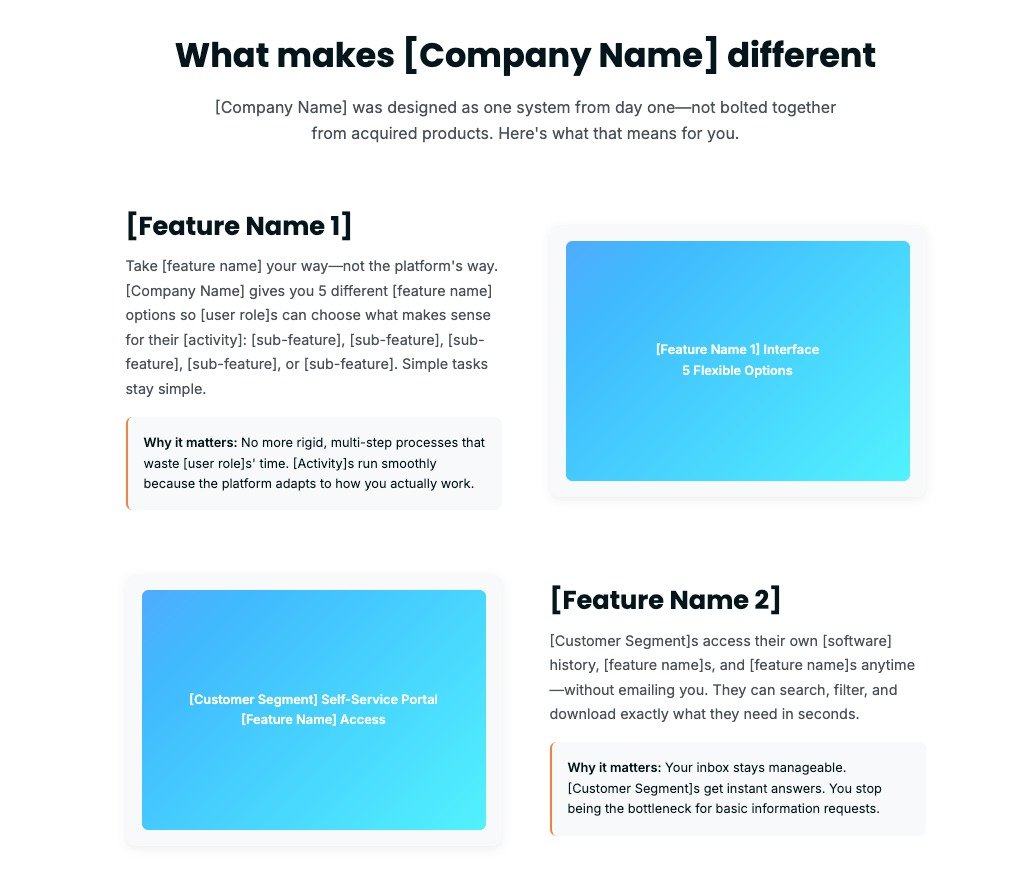
And then comes the “wow” moment: the tool pulls it all together into a full landing page draft, complete with sections, copy, and even a lightweight HTML mock-up.
What used to take days of back-and-forth now takes minutes, and the quality is anchored in the team’s own strategy and assets.
Here are some anonymized screens of the V1 landing page below, with all sensitive information removed. Of course, with more iterations, it will get better and more specific, but this was a significant improvement over what was there before.
Voila! And it’s done.
What once took days now takes a few minutes, producing sharper, better-aligned content. More importantly, my client walked away with a repeatable AI flow that can scale across the team.
Here’s what I want you to take away:
AI only works when paired with a strong strategy. Start with a business goal, choose one low-risk workflow, and prove the value, then expand.
The tools don’t matter as much as the process. ChatGPT, Claude, Gemini, or purpose-built tools, they all work. What matters is how you design around them.
What’s next?
Over the past year, I’ve worked with PMMs and leaders at fast-growing startups to design AI flows that don’t just save time but also strengthen strategy.
Of course, you can absolutely experiment on your own. But many of my clients chose to work with me because they want to accelerate what they are already good at, with a trusted partner who helps them dig deeper, refine their thinking, and explore bold ideas with confidence. Together, we turn workflows into strategies that win executive buy-in, and that’s what helps them lead with greater clarity, influence, and impact.
👉 If you’d like to explore how coaching can transform your career, simply contact me here.
I’d love to help you build your next strategic flow so you become a truly AI-empowered product marketer and leader. :)